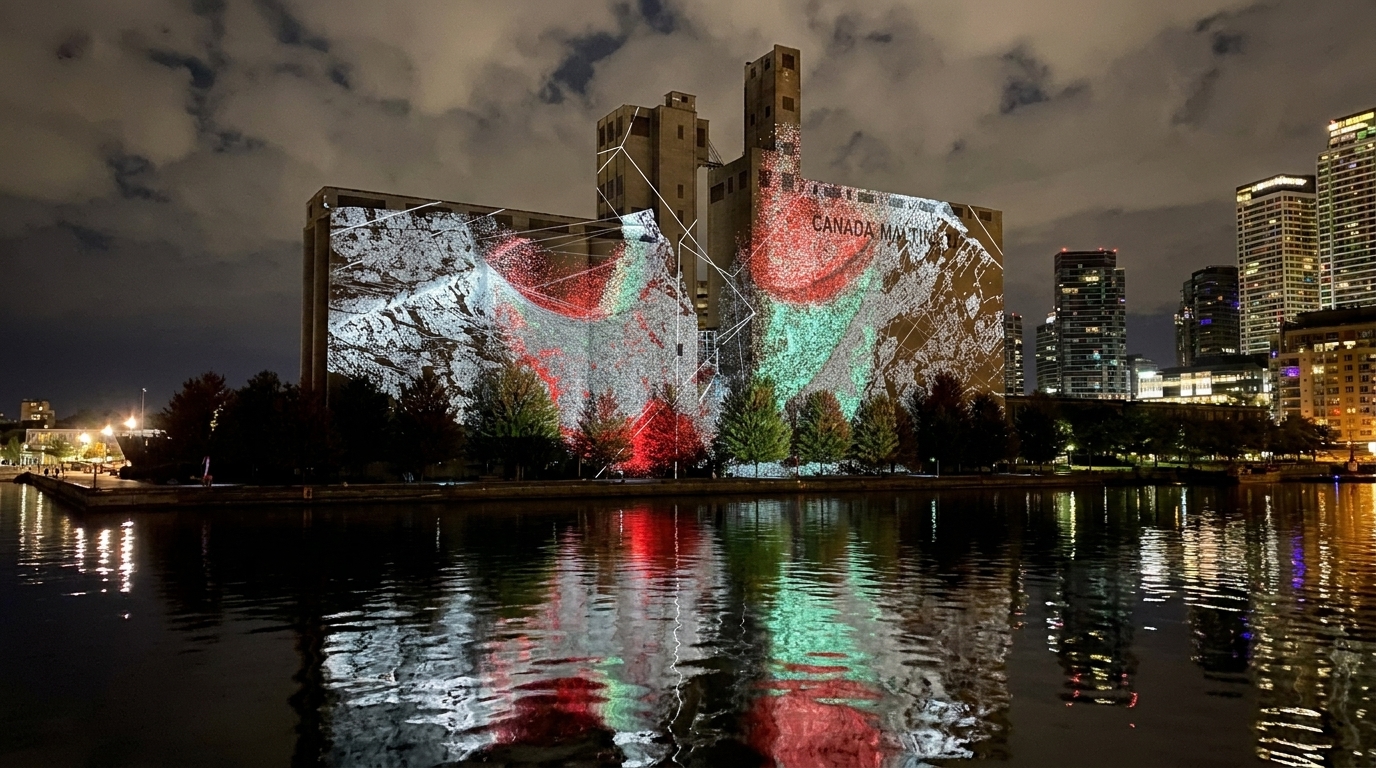
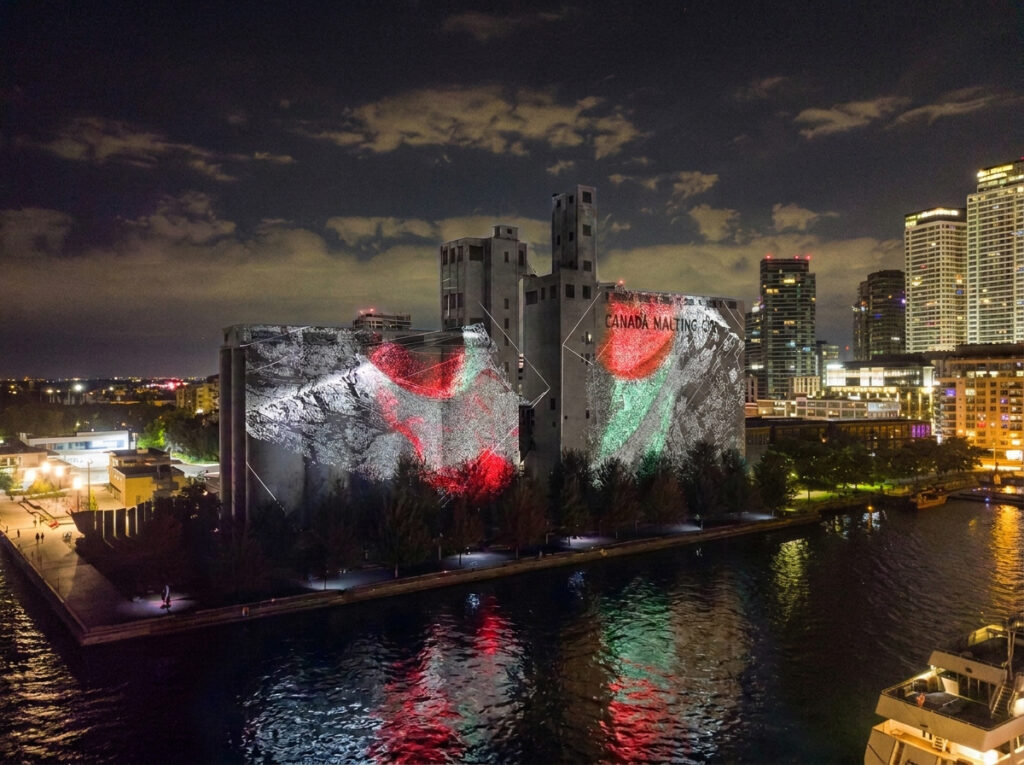
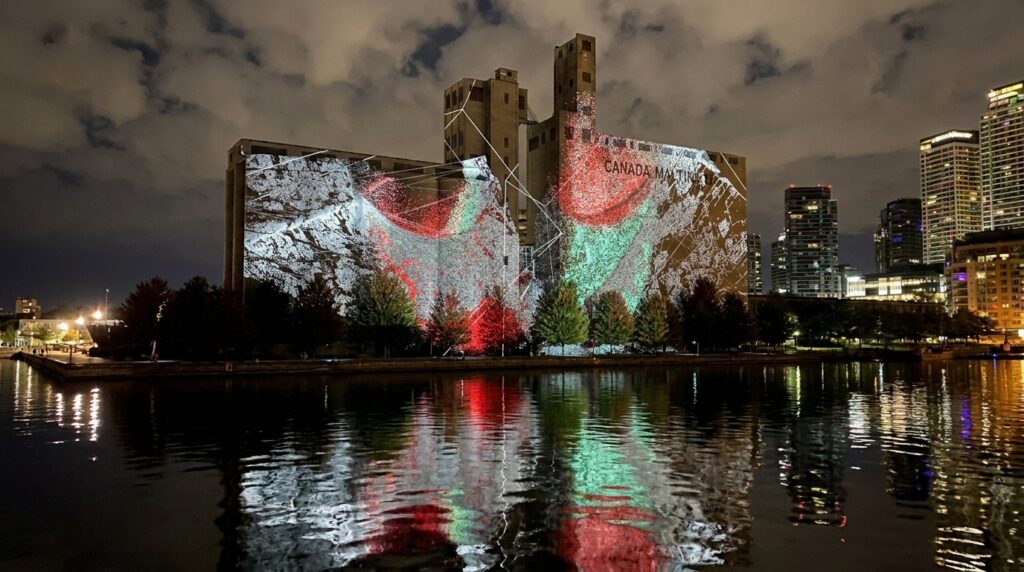
Projected onto the Canada Malting Silos, this immersive artwork transforms street-tree data into light and sound, revealing the interconnected rhythms of Toronto’s urban forest. A living portrait of slow, ongoing growth, it invites us to imagine the city not as it is, but as it could become.
Decomposition No. 7: Undergrowth by Ali Phi is curated and presented in partnership with The Bentway, as part of SILO NIGHTS curated by OCAD University.
On view at Public Pier, a collaboration between The Bentway, Harbourfront Centre, OCAD University and the Waterfront BIA, with the Toronto Port Authority as lead sponsor.
For everyone’s safety, programming may be cancelled in the event of more severe weather. Please follow @thebentway on Instagram for weather-related updates on the day of each performance.
Decomposition No. 7: Undergrowth imagines Toronto as a city shaped by what lies beneath it: root systems threading beneath the street grid, connecting trees across the city, and holding the ground where new growth begins. This new immersive artwork reads the city’s street-tree records, including species, trunk diameter, and location, as a score, transforming data built for maintenance into light, sound, and a portrait of slow, ongoing urban growth.
Continuing Ali Phi’s Decompositions for Computers, this new work treats a series of overlooked civic archives, the City of Toronto’s Street Tree dataset and Natural Feature Projection Area dataset, which log more than half a million individual trees by species, size, and location. From these records, created to document and maintain the trees of the city, grows a new composition, imagining what the city might become.
Sited for the Canada Malting Silos, once a working monument to industrial growth and now the site of future green parkland, the work reflects the cycles of growth and renewal that shape the urban landscape, while projecting a new, greener possibility for the city.
As Toronto keeps building on its industrial past, its future may be written as much in root systems and canopy cover as in concrete and steel. Decomposition No. 7: Undergrowth invites us to hear that future now, in the records we’re already keeping.
What to expect:
Visual
- The work unfolds as a slow aerial view, drifting over a field of glowing points — each one representing a single tree from the dataset. Built with custom code and rendered in black and white across the silos, every point is placed using the tree’s real location and sized by its trunk diameter. Orange and red particles rise upward to show decomposition, while blue-green particles mark new growth taking root. A wireframe cube rotates around the gathering particles, tilting slightly off axis as it fills. Set against the rough texture of the silo walls, the piece uses that surface itself as the ground.
Audio
- A scan line sweeps from south to north across the dataset, turning it into an evolving musical score. Each tree species is assigned a pitch, mapped consistently onto a chosen scale, so the same genus always returns to the same tone. Trunk diameter shapes how the notes are played — older, larger trees ring out longer and strike with more force, while younger trees pass by as short, quiet notes. The whole piece is voiced through a custom synthesizer built specifically for this work.
collaborators
project team
Curator: Alex Rand
SILO NIGHTS, curated by OCAD University as part of Public Pier, transforms the iconic Canada Malting Silos into a giant canvas for immersive art and storytelling — featuring international artists, student collaborations, and Canadian and world premieres.
Public Pier is a collaboration between The Bentway, Harbourfront Centre, OCAD University and the Waterfront BIA, with the Toronto Port Authority as lead sponsor. The partners bring complementary expertise in public space, arts and culture, design, community engagement and waterfront destination development.